Sugar Hill grew up in waves. The little mill-era cottages around the E Broad district came first, back when the gold mill and the rail line were the whole economy. Then came the big one: subdivision after subdivision through the 1990s and 2000s, filling in the land off Level Creek and along GA-20 as Gwinnett boomed north. Ask what a new roof costs here and you are really asking about two different housing stocks with two different price logics. This guide explains both, with the 2026 numbers up front.
The Range, Before Anything Else
A full roof replacement in Sugar Hill starts at $2,999, and most replacements, once the roof is actually measured, land between $9,000 and $20,000. Repairs are a different budget entirely: they start at $499. The inspection that tells you which side of that divide you are on costs nothing and obligates you to nothing.
That $9,000 to $20,000 window sounds wide until you see what it has to cover. A compact cottage roof near downtown and a steep three-gable two-story off Level Creek are not the same product. The spread is the honest answer. The rest of this article is about finding your spot inside it.
Squares: The Unit Your Quote Is Built On
Roofers price surface, not floor plan. The unit is the square, 100 square feet of roof plane, and your roof cost per square in Sugar Hill depends on pitch, complexity, and material before a single shingle brand gets discussed.
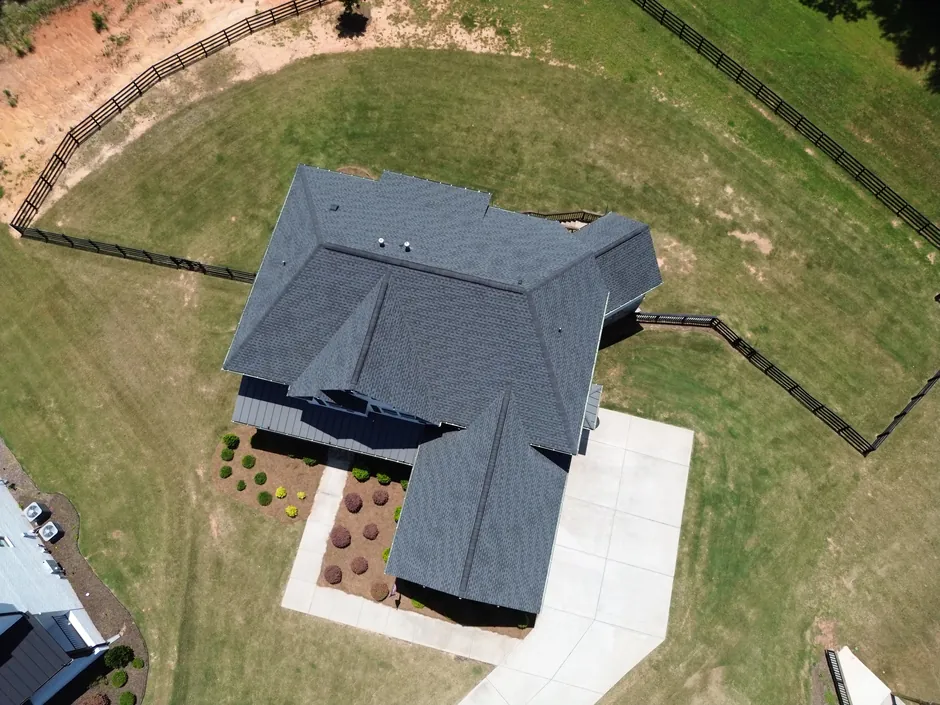
Here is where the two Sugar Hills split. A mill-era cottage might carry 12 to 15 squares on a gentle pitch a crew can walk upright. The subdivision two-stories built in the 90s and 2000s often carry twice the square count, cut into hips, valleys, and dormers, at pitches that require harnesses. Double the squares at a harder degree of difficulty lands you in a different price tier, even though both are “a house in Sugar Hill.”
Age plays in too. Those downtown cottages have usually been roofed several times. Old layers add tear-off labor, and older decking boards fail more often once exposed. The newer stock has predictable sheet decking but bigger, steeper geometry. Neither generation is cheap or expensive across the board; they just spend the money in different places.
If you want your own square count instead of a theory, the instant roof estimate measures your actual roof from satellite imagery and returns a starting range for your address in about a minute.
Every Cost Factor on One Table
| Cost factor | What it actually covers | How it shows up on a Sugar Hill quote |
|---|---|---|
| Roof size | Total squares of real surface, all slopes | The base of the estimate; more squares raise every other line |
| Pitch and complexity | Steepness, hips, valleys, dormers | Slower, harnessed work on the tall 90s-2000s stock; minimal on cottage gables |
| Material | 3-tab, architectural, designer, or metal | Architectural is the local default; metal costs more up front and lasts decades longer |
| Tear-off and decking | Removing old layers, replacing rotted boards | Extra labor and material, most common on the older E Broad area homes, approved by you first |
| Ventilation | Ridge and soffit airflow for the attic | Corrections start around $400 and protect the new shingles from cooking |
| Storm damage | Hail and wind claims through insurance | Insurance may cover most of the project; you pay your deductible |
Read the table top to bottom and you can roughly assemble your own situation. Small simple roof, no decking drama, architectural shingles: the lower end of the range. Big cut-up roof, a layer to tear off, a ventilation fix: the upper end, and worth every dollar because all of it goes onto your house rather than into vagueness.
One more line item people forget: the roof replacement itself includes full tear-off, disposal, decking inspection, new flashing, and ventilation verification here. Quotes that look cheaper sometimes just contain less.
What Size and Material Do to the Price
The factor table tells you what moves the number. Brackets tell you where it tends to stop. On a roof of average complexity in architectural shingle, a small home under 1,500 square feet usually prices between $7,600 and $10,400. A medium home, 1,500 to 2,500 square feet, runs $10,500 to $14,300. A large one, 2,500 to 3,500 square feet, lands between $14,300 and $19,500. Much of the older stock near the E Broad district lives at the small end of that scale. The two-story subdivision stock tends to fill the upper brackets.
Metal is a different scale entirely. The same small roof runs $14,400 to $24,000 in metal, and a large one can reach $27,000 to $45,000. Nobody chooses metal to save money in year one. The case for it takes decades to pay off: it outlasts multiple shingle cycles, shrugs off Georgia heat aging, and spares you a second tear-off. On a forever house off GA-20, that math can work. If you might sell within ten years, architectural shingle usually pencils out better.
What about 3-tab? It exists, it costs less, and the lifespan penalty usually outweighs the savings. Architectural stays the local default for a reason. Whatever the material, the steep, cut-up geometry described earlier pushes each of these figures up, and a walkable cottage gable pulls them down.
Repair or Replace: How to Pick a Side
Back to the divide from the top of this article: repairs start at $499, and a targeted leak fix can start at $250. Replacement starts at $2,999 and, once measured, usually runs into five figures. The gap between those numbers is the whole decision, and roof age is what settles it.
Repair wins when the damage is an accident, not a symptom. A wind-lifted shingle tab after a spring storm, a flashing gap where the chimney meets the roofline, one leak traced back to a debris-clogged valley: those are contained problems on a roof that still has life in it. If your shingles are inside their first 12 to 15 years and the trouble sits in one spot, roof repair is the sane budget, and a $200-a-year maintenance plan keeps the next surprise small.
Replacement wins when the repairs stop staying fixed. Granule loss across whole slopes, shingle edges curling or going brittle, a second and third leak in different places within a couple of years: that is a roof announcing its retirement. Paying $499 a few times a year to chase leaks across a 22-year-old roof is not thrift. It is a replacement bill on layaway, with interior drywall repairs thrown in.
There is a middle case, and it is common: a roof around 17 or 18 years old with moderate trouble. A repair can buy two or three more years, and sometimes that is exactly the right move while you line up savings or decide whether you are staying in the house. Just buy those years with your eyes open. Money spent patching does not roll over into the replacement later.
Sugar Hill adds a twist of its own. Whole subdivisions went up together in the 90s and 2000s, so whole streets reach roof-retirement age together. When neighbors with the same builder and the same vintage start replacing, treat that as free information about your own shingles. And if hail or wind did the damage, the question changes shape entirely, because the insurance path below may cover most of a full replacement.
None of this requires guessing. The free inspection settles which side of the divide you are on, with photos and a written call rather than a sales pitch.
Paying for It: Financing and the Insurance Path
Two facts change how Sugar Hill homeowners actually fund a roof.
First, financing exists and is boring in a good way. Flexible plans through approved lending partners spread the cost into low monthly payments, which beats postponing a failing roof until it converts into an interior repair bill. You do not need the full figure sitting in savings to schedule the work.
Second, if a storm did the damage, you may not be funding most of it at all. Gwinnett’s spring hail and wind events are claim events. The process here includes photo documentation, measurements, a meeting with your insurance adjuster on the roof, and help with the paperwork, at no charge. When a claim is approved, your cost is typically the deductible. The difference between a denied claim and an approved one is often just the quality of the documentation, so start with the free inspection rather than a phone-photo guess.
Getting From a Range to Your Number
Here is the short version of a sane 2026 budget plan. Run the calculator for your address so you start from your measured square count. Book the free inspection so decking, layers, flashing, and ventilation stop being unknowns. Then read the written, itemized estimate, which is the only number that deserves a place in your budget. No hidden fees, and nothing moves without your approval.
The work itself is done by our own local Sugar Hill crew. Schedule your free inspection online or call (470) 777-7344. Whether your roof shelters a cottage that predates The Bowl or a two-story that went up with the subdivisions, the price of certainty is the same: zero.
Wondering what this means for your budget? Get an instant roof estimate for Sugar Hill, priced from your home's actual roof size, or run a quick storm damage and insurance check.